


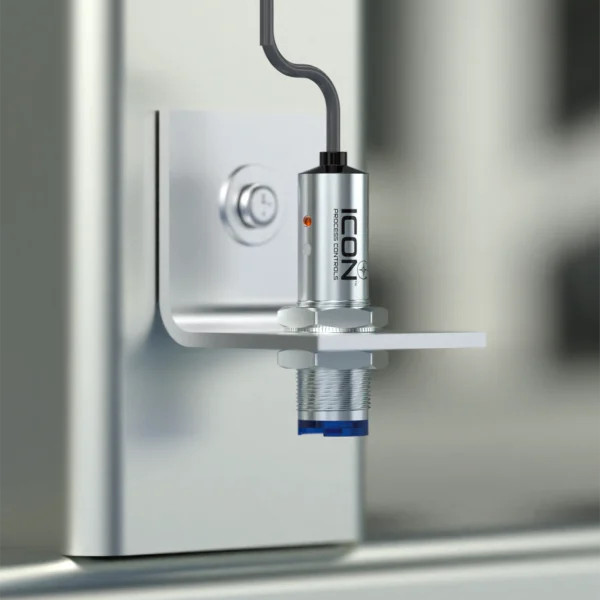
PES Series Photoelectric Leak Detection Sensor
PES Series Photoelectric Leak Detection Sensor with diffuse reflective sensing technology for fast detection of conductive and non-conductive liquids.
Compact M18 design with adjustable sensitivity, IP66/IP67 protection depending on version, and rugged plated steel or PBT housing.
Ideal for data centers, glycol and coolant systems, tanks, sumps, pumps, piping and applications where conductivity-based leak sensors are not suitable.
Description
PES Series Photoelectric Leak Detection Sensor
The ICON Process Controls LeakPro® PES Series Photoelectric Leak Detection Sensor is engineered for precise and reliable point leak detection in industrial automation systems, chemical processing facilities and mission-critical infrastructure.
It uses diffuse reflective photoelectric sensing technology to detect liquid presence by monitoring reflected light from the target surface, eliminating the need for a separate reflector or receiver.
Because the PES operates optically rather than through electrical conductivity, it can detect both conductive and non-conductive liquids. This makes it particularly valuable for glycol, coolant and dielectric-fluid applications where conductivity-based sensors may not be suitable.
The series is available with rugged plated steel or PBT plastic housings, with IP66 / IP67 protection depending on version, short-circuit protection and polarity protection.
Its compact M18 threaded body simplifies installation in tight spaces, while adjustable sensitivity allows site-specific calibration according to the target, sensing distance and installation conditions.
Key Benefits
- Fast photoelectric liquid detection.
- Detects conductive and non-conductive liquids.
- No separate reflector or receiver required.
- Adjustable sensitivity for site-specific calibration.
- Compact M18 threaded design.
- IP66 / IP67 protection depending on version.
- Short-circuit and reverse-polarity protection.
- Solid-state design with no mechanical wear.
- Low maintenance requirements.
- Multiple output configurations depending on version.
Applications
- Data centers and server rooms
- Glycol and liquid cooling systems
- Cooling Distribution Units (CDUs)
- Rear-door heat exchangers and cooling loops
- Chemicals | Acids | Bases
- Dosing pumps and pump skids
- Tanks and sumps
- Double-walled tanks
- Secondary containment
- Piping, valves, pumps and fittings
- Control rooms and critical industrial facilities
Technical Specifications
| Specification | PES-40 | PES-30 |
| Sensing Method | Diffuse Reflective Photoelectric | Diffuse Reflective Photoelectric |
| Sensing Range | 0–40 cm | 10–30 cm |
| Mounting Thread | M18 | M18 |
| Adjustable Sensitivity | Yes | Yes |
| Short-Circuit Protection | Yes | Yes |
| Reverse-Polarity Protection | Yes | Yes |
| Housing Material | Plated steel or PBT depending on version | |
| Ingress Protection | IP66 / IP67 depending on version | |
| Response Frequency | 500–600 Hz depending on model | |
| Output Options | NPN / PNP / NO / NC | Depending on model configuration |
| Connection | PVC cable / connection options depending on version | |
Exact electrical parameters and output configuration should be confirmed for the specific PES model selected or ordered.
IMPORTANT
PES photoelectric technology can detect conductive and non-conductive liquids without relying on the electrical conductivity of the fluid.
The ability to optically detect a chemical liquid does not automatically confirm chemical compatibility of the sensor housing with that fluid. The appropriate PES version should be selected according to the fluid, concentration, temperature and actual installation conditions.
Optical sensing performance may be affected by dirt, coatings or residue on the sensing area. Correct installation and periodic inspection of the sensing surface are recommended.
TIP
For glycol, dielectric coolant and other non-conductive liquid applications, the PES Series is particularly useful where conductivity-based leak sensors may not provide reliable detection.
In data centers, PES sensors can be installed at low points, drip trays, beneath racks, near CDUs, chillers and cooling-loop connections where even small coolant leaks may accumulate.

Ask A Quote
Fill the form to get a quote or more information about the product.


